Septic Repair in Oklahoma City
Backups, alarms that will not clear, failed aerators and pumps, broken lids and soggy lateral fields. Here is what usually went wrong and how it gets fixed.
The short answer
Find the Failed Part Before Anyone Digs
Backups, alarms, smells and soggy ground each point to a different part of the system. On an aerobic system the usual suspects are the aerator, the pump, the floats, the timer and the spray heads. On an older conventional system it is the baffles, the distribution box, the lines or a field that has stopped taking water.
If your aerobic system is still inside the installer's two-year mandatory maintenance period, call the installer first: Oklahoma rules make them responsible for repairing broken or malfunctioning parts at no extra cost (OAC 252:641-10-3).
Symptoms
What You Notice and What It Usually Means
| What you notice | Likely cause |
|---|---|
| Every drain in the house is slow or gurgling | Tank overfull, a blocked outlet or effluent filter, or a lateral field that is no longer taking water |
| One toilet or sink is slow | A clog in the house plumbing, not the septic system |
| Aerobic alarm sounding and not clearing | Pump failure, stuck float, tripped breaker, or the pump tank flooded |
| Sewage smell from an aerobic system | Aerator not running, a cracked or kinked air line, or an overloaded system |
| Spray heads throwing cloudy or smelly water | Solids carrying over from a full trash tank, aeration failure, or an empty chlorinator |
| Wet, green strip over the laterals in dry weather | Field saturation or a broken line |
| Puddles in the spray field after every cycle | Too much water for the area, a timer set wrong, or a head stuck open |
By system type
Common Septic Repairs in OKC
Aerobic system repairs
Aerobic systems are now the most common type installed in Oklahoma, and they have the most parts that can fail (OSU Extension).
- Aerators and compressors that wore out or overheated
- Pumps and float switches in the pump tank
- Timers and control panels hit by storm power surges
- Spray heads broken by mowers or stuck up after a freeze, and cut drip lines
- Chlorinators clogged with the wrong tablets
Conventional system repairs
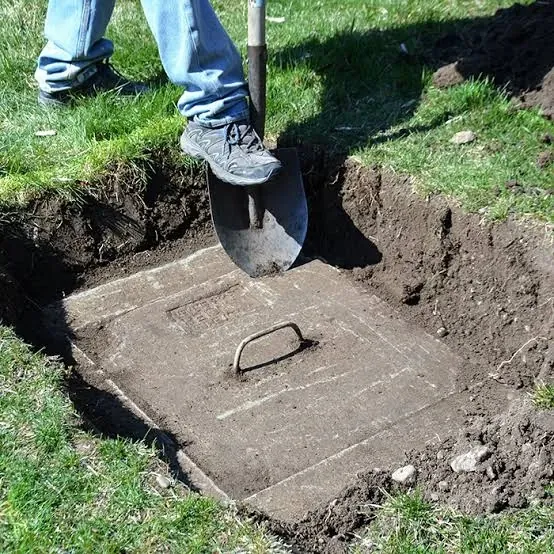
Older tank-and-lateral systems fail in slower ways, and the first step is often finding lids buried a foot or more down.
- Inlet and outlet baffles rusted away or cracked
- Distribution boxes tipped as the clay swells and shrinks
- Lines crushed by vehicles or filled with roots
- A field sealed by years of solids that stops taking water
- Risers added while the tank is open to save future digging
Permits
When a Repair Needs a DEQ Permit
A tank problem is usually a straightforward fix. A failed field is a bigger job, and because Oklahoma's heaviest clay soils do not allow a conventional absorption field at all, replacing a field sometimes means changing to a different type of system. That is a modification, and it needs a DEQ Authorization to Construct before work starts (OSU Extension, PSS-2411). Moving a component or adding bedrooms counts too. See septic installation in OKC for the process.
While you wait for a repair
- Cut water use: no laundry, no dishwasher, short showers.
- Reset an aerobic system's breaker once. If it trips again, leave it off.
- Keep children and pets away from wet areas and open lids.
- Skip chemical drain openers and septic additives.
FAQ
Septic Repair Questions
Do septic repairs in Oklahoma need a permit?
Repairs that modify the system do. Oklahoma requires an Authorization to Construct from DEQ for new installations and for modifications to an existing system, including work after a malfunction and moving any component. Replacing a part with the same part, like a float switch or an aerator, generally does not change the system.
Why is sewage coming up in my yard?
Surfacing usually means the lateral field is saturated or failing, the tank is overfull, or on an aerobic system a spray head or line has broken. It is also a violation of the owner's duties under Oklahoma rules, so it should be fixed promptly. Keep people and pets away from the area.
How long does an aerobic aerator last?
It depends on the brand, how hard it runs and whether the air filter is kept clean. Aerators run around the clock, so a failed one is one of the most common aerobic repairs. A quiet system with a sewage smell is the usual sign.
Can roots get into septic lines?
Yes. Willows, cottonwoods and other thirsty trees planted near the tank or the field send roots into joints and cracks, especially in a dry summer. Roots in a lateral line slow drainage and can crack the pipe.
Free quote
Report a Septic Problem
Tell us what you are seeing, how long it has been going on and the system type if you know. We will tell you what to check, whether it can wait, and what the visit costs.
- Pumping, aerobic service, repair and new systems
- All of Oklahoma City
- Price explained before any work starts
Prefer to talk? (405) 913-6058